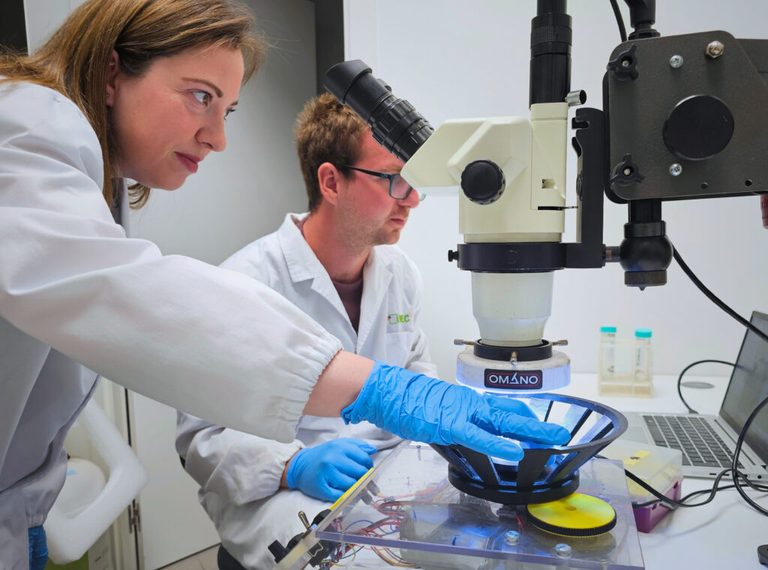
Researchers have developed a novel class of biophotonic scaffolds that respond to near-infrared (NIR) light to enable controlled, localized drug release, marking a significant step forward in the design of advanced biomaterials for medical applications. These materials hold promise for therapies where precise spatial and temporal control of drug activation could improve treatment outcomes while minimizing unwanted side effects.
The development of new biomaterials lies at the heart of many advances in medicine, from tissue repair and regenerative therapies to targeted treatments for a range of diseases. Materials that can respond to specific physiological or external triggers offer clinicians tools to place therapy precisely where and when it is needed. Among these triggers, light-responsive systems have attracted particular interest because light can be delivered non-invasively, controlled with high accuracy, and tuned to penetrate tissues effectively. Near-infrared light, in particular, occupies a so-called therapeutic “optical window” that allows deeper penetration into biological tissues compared with ultraviolet or visible light, while minimizing damage to surrounding cells and structures. This makes NIR an especially attractive stimulus for medical devices, as it can be delivered safely using standard optical devices, and drug release platforms that seek to act deep within the body.
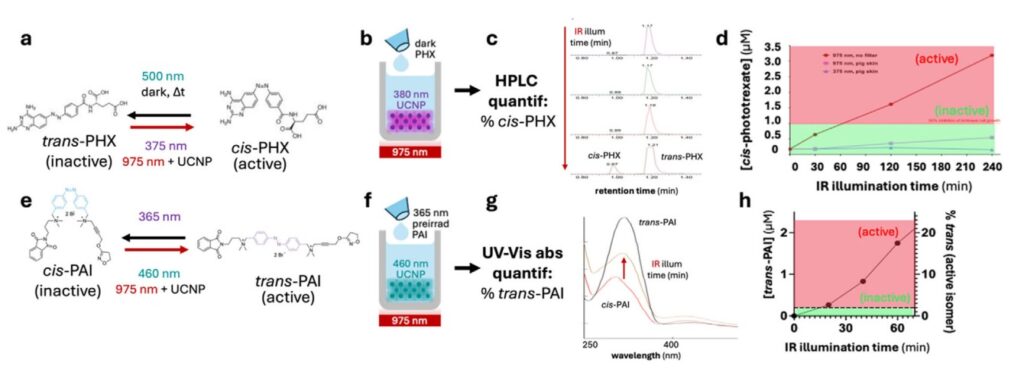
In a recently published study in Advanced Healthcare Materials, PHOTOTHERAPORT researchers presented a new approach to creating 3D-printed, bioresorbable biophotonic scaffolds that exhibit controlled release of therapeutic agents upon exposure to near-infrared light. These scaffolds are engineered with embedded crystals capable of converting NIR light into visible emission, thereby activating drug release or other biological signaling functions on demand. In laboratory tests, the structures not only demonstrated luminescence under NIR illumination, but also successfully released signaling molecules and modulated the activity of photoresponsive compounds in a controlled manner. Importantly, preliminary biocompatibility studies with human adipose stem cells suggest that both the scaffolds and their degradation products are well tolerated, supporting their potential for future implantation.
This work underscores the importance of designing smart biomaterials that respond predictably to external cues. Traditional drug delivery approaches often rely on systemic administration that exposes the whole body to therapeutic agents, with consequent risks of side effects and suboptimal dosing. By contrast, materials that release drugs locally — and only in response to a specific, externally applied stimulus such as near-infrared light — could allow clinicians to tailor treatment with unprecedented precision.
Looking ahead, the concepts demonstrated in this research may open the doors to the development of a new generation of light-activated therapeutic systems that could be applied in a range of clinical contexts where controlled, site-specific drug delivery is critical, including cancer therapy, tissue regeneration, and management of chronic disease. By integrating advanced materials science with photonic control strategies, this line of research opens promising avenues toward therapies that are both more effective and kinder to patients’ overall health.
Reference article:
“Novel 3D-Printed Biophotonic Scaffold Displaying Luminescence under Near-Infrared Light for Photopharmacological Activation and Biological Signaling Compound Release”. Sonya Ghanavati, Ekin Opar, Virginia Alessandra Gobbo, Carlo Matera, Fabio Riefolo, Rossella Castagna, Julien Colombelli, Andrew Draganski, Joshua Baggott, Mika Lastusaari, Pau Gorostiza, Laeticia Petit, Jonathan Massera. Adv. Healthcare Mater. (2025): e02163. https://doi.org/10.1002/adhm.202502163