Researchers from the PHOTOTHERAPORT partner LIOS, in collaboration with University of Milan, recently published a scientific study that presents a light-controlled strategy to reduce Pseudomonas aeruginosa (PA) virulence. The work targets LecB, a protein essential for PA biofilm stability and tissue adhesion. Using photopharmacology, they designed two photoswitchable molecules (photofucose-1 and photofucose-2) featuring a photoswitchable azobenzene group that enables reversible, light‑driven changes in shape and binding affinity. This approach demonstrates how light can act as a non-invasive tool to weaken bacterial defences, offering a precise method to reduce side effects and limit the selective pressure behind antibiotic resistance.
Bacterial multi-drug resistance has emerged as a significant threat to global health, with current projections suggesting that related deaths could reach 10 million annually by 2050. Among the most concerning pathogens is Pseudomonas aeruginosa, a bacterium commonly found in the environment worldwide and notorious for causing severe respiratory infections. It is a big threat especially for hospitalized and immunocompromised patients, and in 2024 the WHO classified it as a high-priority pathogen. One of the reasons for PA’s development of drug resistance is its ability to form biofilms – structured bacterial communities embedded in a self-produced protective matrix that shields them from both the host’s immune system and conventional antibiotic treatments.
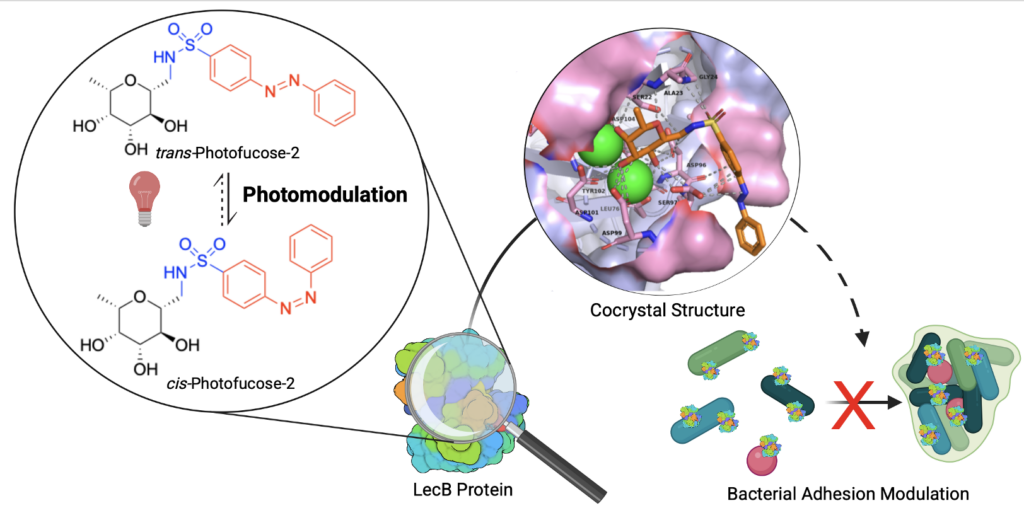
Central to this defensive strategy is a protein called LecB, a tetravalent carbohydrate-binding lectin which has a well-documented role in biofilm formation. This lectin has been appointed as a valuable target for new PA biofilm inhibitors by previous research, which demonstrated that glycopeptide dendrimers targeting LecB were able to completely inhibit and disperse biofilms. Moreover, because LecB is located on the outer membrane of the bacterium, it represents an ideal target for new therapies, as drugs do not need to penetrate the complex inner layers of the cell to be effective.
PHOTOTHERAPORT researchers introduced a new approach to tackle this challenge: photopharmacology, which involves using light as a non-invasive “remote control” to activate or deactivate drugs with extreme precision. By incorporating photoswitchable groups into medicinal molecules, researchers can ensure that antibacterial activity is confined strictly to where and when it is needed. This localized control could significantly reduce the side effects typically associated with systemic drug exposure and mitigate the development of resistance by decreasing the constant selective pressure that traditional antibiotics exert on bacteria.
In this study, LIOS researchers developed two novel light-responsive molecules – photofucose-1 and photofucose-2 – designed to mimic the natural sugars that LecB binds to. These compounds were engineered to undergo a reversible change in shape when exposed to specific wavelengths of light, switching between a trans and a cis form. Detailed biophysical analysis using Isothermal Titration Calorimetry confirmed that photofucose-2 binds to the LecB protein with high affinity. Crucially, the strength of this binding changes significantly depending on which light-induced shape the molecule takes, demonstrating that its inhibitory activity can indeed be modulated by light.
To understand this interaction at a molecular level, the scientific team successfully determined the X-ray crystal structure of the LecB protein in complex with photofucose-2 at a very high resolution of 1.49 Å. This structural map revealed how the molecule fits into the protein’s binding pocket, stabilized by calcium ions and specific interactions with key amino acids like Ser97.
The research presented in this study marks a significant step forward in the development of precision tools to combat bacterial virulence. By demonstrating that light can be used as a non-invasive “remote control” to modulate the activity of the LecB protein, the researchers have provided a vital blueprint for future antimicrobial strategies.
The challenge of bacterial multidrug resistance is inextricably linked to the success of implants and medical devices, which represent a core focus of the PHOTOTHERAPORT project. These findings lay a solid foundation for a new class of light-responsive agents that could eventually be integrated into medical technologies to dismantle bacterial defences, minimize systemic side effects, and mitigate the global crisis of antibiotic resistance.
Reference article:
“Synthesis, photochemical and biological evaluation of novel photoswitchable glycomimetic ligands of Pseudomonas aeruginosa LecB”. Shapla Bhattacharya, Giorgia Tempra, Alessio Colleoni, Carlo Matera, Rossella Castagna and Emilio Parisini. RSC Advances (2025). DOI: 10.1039/d5ra06897e