Two PHOTOTHERAPORT researchers took part in the 2026 edition of the European Researchers’ Night in Barcelona with two micro-talks organised by the Catalan Association for Science Communication (ACCC): Galyna Malieieva (IBEC) gave an in-person micro-talk on photoswitchable drugs at the Gabriel García Márquez library, while Cristina López Cabezón (IIBB-CSIC) shared her research through a video micro-talk available on the event’s YouTube channel.
The European Researchers’ Night is a Europe-wide public event, funded by the European Commission through the Marie Skłodowska-Curie Actions (MSCA) under Horizon Europe, that brings researchers and citizens together. Held every year around the last Friday of September, it takes place simultaneously in hundreds of cities in more than 25 European countries and attracts over a million visitors. Through talks, workshops, experiments and games, its aim is to show how research impacts everyday life, celebrate scientific achievements and spark young people’s interest in research careers. In Catalonia, La Nit de la Recerca offered more than 250 activities across five territorial nodes; in the Barcelona–Vallès node, coordinated by ISGlobal, the Catalan Association for Science Communication (ACCC), the University of Barcelona and the Autonomous University of Barcelona, activities ran from 22 September to 2 October.
In-person micro-talk at the Gabriel García Márquez library
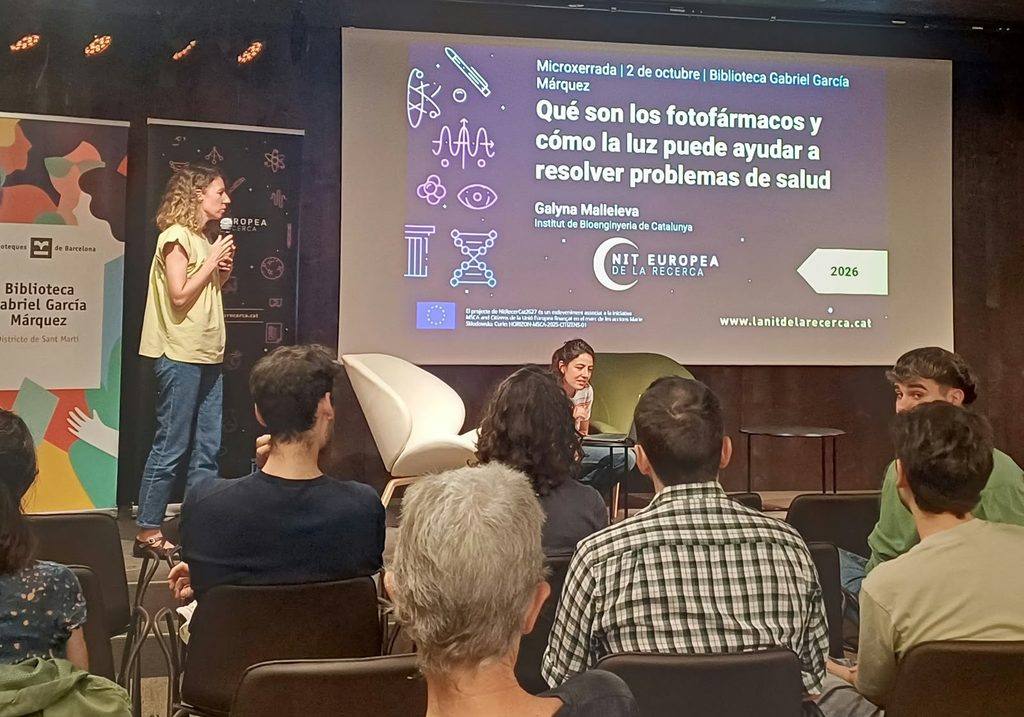
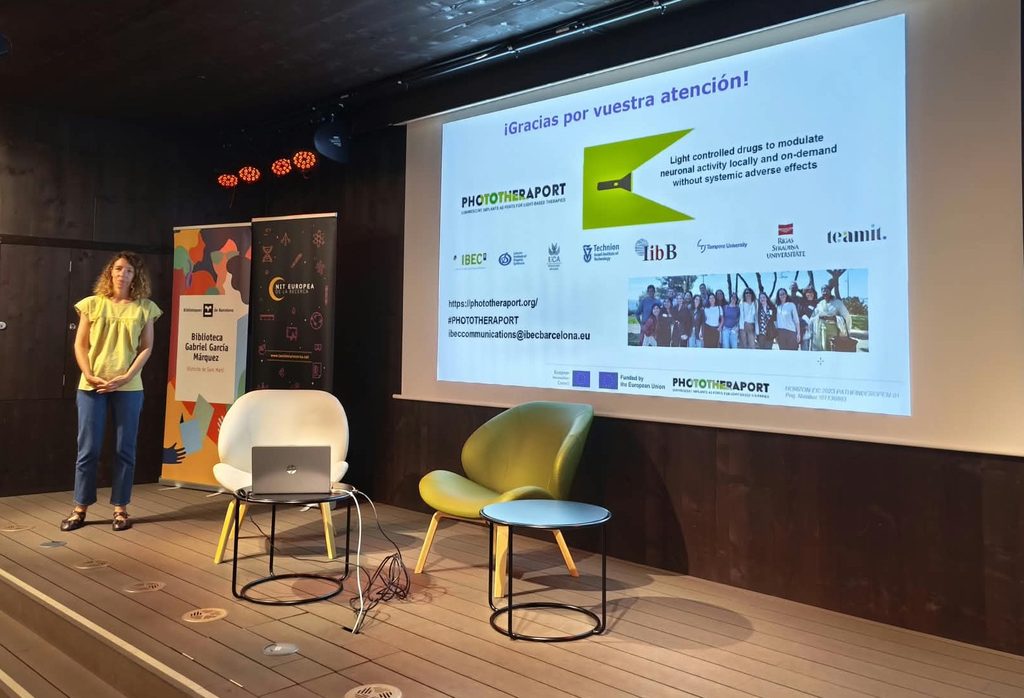
On Friday 2 October, Galyna Malieieva, researcher in the Nanoprobes and Nanoswitches group at IBEC, led by PHOTOTHERAPORT coordinator Pau Gorostiza, delivered the micro-talk “What are photoswitchable drugs and how can light help solve health problems?” to an audience of around 30 people at the Gabriel García Márquez library in Barcelona.
Malieieva invited the audience to imagine having “tiny light bulbs” inside the body that can be switched on from the outside. These light bulbs are, in fact, miniature light-emitting implants — light ports guided by nanocrystals — that convert invisible infrared light applied from outside the body into visible light. When placed exactly where a treatment is needed, they can illuminate a photoswitchable drug: a medicine synthesised in an inactive form that only becomes active when it is excited with a specific light. This combination allows the treatment to be activated only where and when it is needed, making it more controlled and localised, increasing its efficiency and reducing side effects.
The talk also explored how the “light-emitting implant – light-controlled drug” approach being developed within PHOTOTHERAPORT could open new possibilities for treating conditions of the nervous system, such as localised pain and epileptic seizures.
Video micro-talk on YouTube
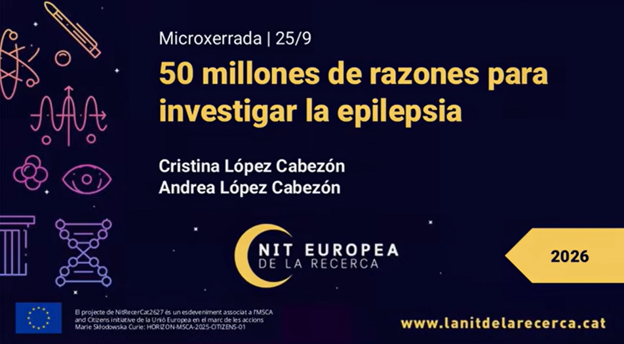
PHOTOTHERAPORT was also present in the online programme of La Nit de la Recerca. Cristina López Cabezón, PhD student at Victoria Puig’s group at the Barcelona Institute for Biomedical Research (IIBB-CSIC), recorded a video micro-talk entitled “50 million reasons to research epilepsy”.
In the talk, López explains that epilepsy is a neurological disorder affecting more than 50 million people worldwide, in which seizures caused by abnormal electrical discharges in the brain can appear unpredictably. Beyond the seizures themselves, people with epilepsy often face significant social stigma. Although treatments exist, around one in three patients does not respond adequately to them, and many current drugs also affect normal brain function, causing important side effects.
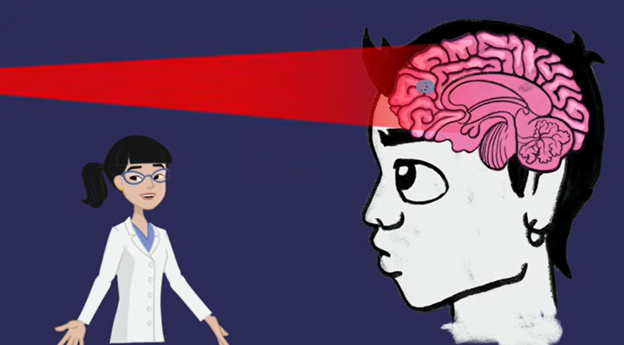
To address this challenge, she presents the approach of PHOTOTHERAPORT: administering a drug that remains inactive until it is switched on by light, only in the brain region where seizures originate. This makes it possible to control exactly where, when and for how long the treatment acts. To deliver that light, the project is developing tiny, biocompatible implants that can be activated non-invasively from outside the body using infrared light, and that could be adapted to different types of epilepsy.
The ultimate goal, López concludes, is to achieve more precise, safer and personalised therapies, with fewer side effects and a better quality of life for patients — because behind the figures there are “50 million stories, 50 million reasons” to keep researching.
The video is available on La Nit de la Recerca YouTube channel. Watch it here: https://www.youtube.com/watch?v=l8yzR0dQ4Rc
Through both formats, PHOTOTHERAPORT researchers brought the science behind light-activated therapies closer to citizens. Taking research beyond the lab and into dialogue with society is part of the project’s commitment to open, accessible science.