A team led by PHOTOTHERAPORT project coordinator Pau Gorostiza (IBEC) has developed prosthe6, a new family of light-activated small molecules that restore key visual behaviours in animal models of retinal degeneration — without gene therapy or implanted devices. The results, published in the Journal of the American Chemical Society, offer a proof of concept for a photopharmacology-based route to future vision-restoration therapies.
Blinding diseases caused by photoreceptor degeneration, such as age-related macular degeneration (AMD) and retinitis pigmentosa (RP), affect an estimated 200 million people worldwide and are among the leading causes of visual impairment. In these conditions, the light-sensing photoreceptor cells progressively die off, but much of the downstream retinal circuitry survives — it simply no longer receives the light signals needed for vision. Existing options, from gene therapy to electronic retinal implants, are either mutation-specific, invasive, or costly, leaving a clear gap for a broadly applicable, non-invasive alternative.
The team turned to photopharmacology, a strategy — central to PHOTOTHERAPORT’s own approach to light-controlled therapeutics — that uses light to switch a drug’s activity on and off reversibly. The prosthe6 compounds are designed to act on ON-bipolar cells, the retinal neurons that normally relay signals from photoreceptors onward. By binding the mGlu6 protein in this still-intact circuitry, prosthe6 changes shape when it absorbs light, generating a retinal signal that mimics what a healthy photoreceptor would produce. In effect, the molecule behaves as a “molecular prosthesis” standing in for the missing photoreceptor.
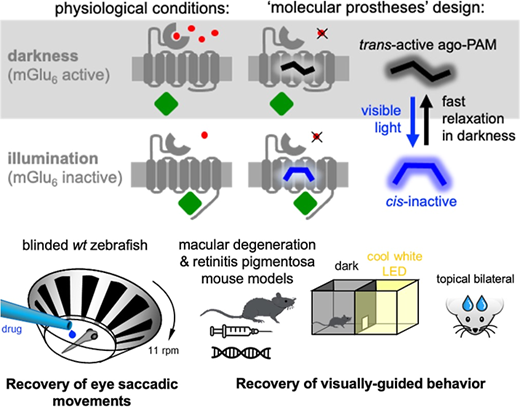
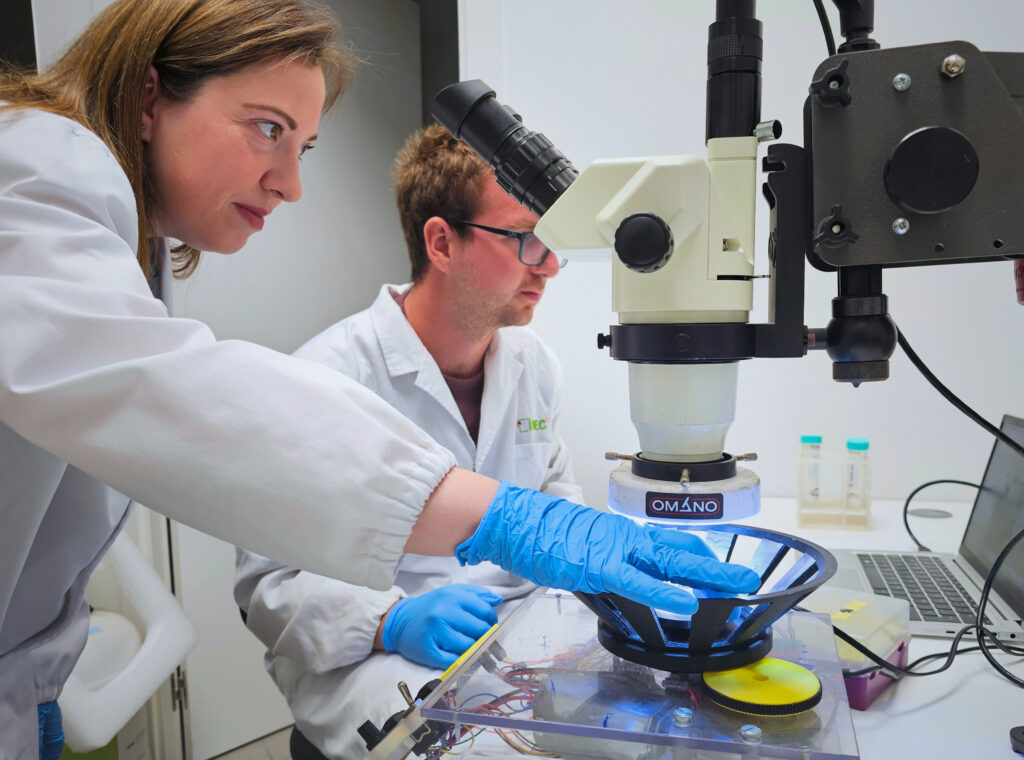
Administered by intraocular injection, or just by eye drops, prosthe6 restored the optokinetic reflex (light-guided eye movements) in blinded zebrafish larvae, and recovered innate light-avoidance behaviour in mouse models of both AMD and RP. Healthy mice instinctively seek out dark areas and avoid bright light, a preference that depends on a working visual system and disappears in blind animals; after treatment, blind mice regained this spontaneous preference under ordinary indoor and overcast light levels, with no training required. Two lead candidates, prosthe6-12 and prosthe6-15, performed well through both delivery routes, and unlike optogenetic or upconversion-based approaches, the compounds work with ordinary visible or white light rather than specialised light sources.
“These molecules do not cure blindness. But they are remarkably effective at restoring sight, and they do so using a very simple and potentially patient-friendly approach,” said Pau Gorostiza, ICREA Research Professor and leader of the Nanoprobes and Nanoswitches group at IBEC. Co-first author Rosalba Sortino, who carried out this work as part of her PhD at the University of Barcelona, added: “Our goal was to restore vision using a molecular mechanism that is as close as possible to how the healthy retina works.”
These are still animal-model results, and Gorostiza is careful to frame what comes next: “Turning this into a therapy is a long and laborious process. But the results show that there is a realistic possibility of restoring high-quality vision with drugs, non-invasively, reversibly and with a mechanism that is independent of the specific retinal disorder or genetic mutation, to reach a majority of patients.” The consortium is now evaluating safety and formulation to extend how long the restored vision lasts, working with the spin-off in formation Eyelumina to advance the compounds toward clinical development.
For PHOTOTHERAPORT, whose own mission centres on light-controlled drugs that act locally and on demand, prosthe6 is a striking demonstration of what photopharmacology can achieve in a real disease context — turning a reversible, light-triggered molecular switch into a functional stand-in for lost sensory cells.
Reference article:
“Restoration of saccadic eye movements and visually guided behavior in ambient white light with photoswitchable small molecules.” Rosalba Sortino, Aleix González-Díez, Santiago Milla-Navarro, Joaquín Martínez-Tambella, Víctor Paleo-García, Eric Calatayud, Paula de Saralegui, Ekin Opar, Àlvar Claparols, Josecarlo A. Quintanilla, Xavier Martínez-Soler, Fabio Riefolo, Carlo Matera, Jordi Hernando, Alexandre M. J. Gomila, Gerard Pérez-Batlle, Carles Pereira, Núria Camarero, Carme Serra, Xavier Gómez-Santacana, Amadeu Llebaria, Xavier Rovira, Pedro de la Villa, Pau Gorostiza. Journal of the American Chemical Society (2026). DOI: 10.1021/jacs.5c18611
You can also check out the video below illustrating the molecular photoswitches to restore vision: