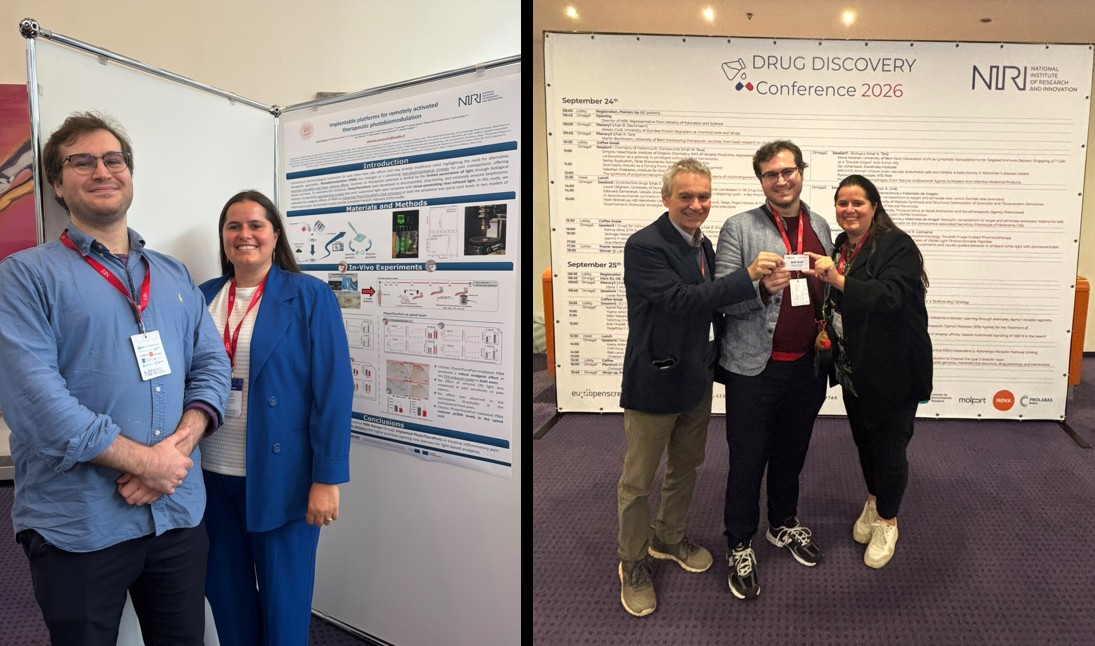
PHOTOTHERAPORT researchers from the National Institute of Research and Innovation (NIRI, formerly the Latvian Institute of Organic Synthesis) and the Institute for Bioengineering of Catalonia (IBEC) took part in the 3rd Drug Discovery Conference, held in Riga, Latvia, on 24–25 September 2026. Organised by NIRI in co-organisation with EU-OPENSCREEN, the event featured two posters and a talk linked to the project, and NIRI researcher Alessio Perazzoli received the conference’s Best Poster Award for his work on implantable platforms for remotely activated phototherapy.
Conceived as a forum for researchers from academia and industry worldwide to present their latest results, exchange ideas and foster new collaborations, the 3rd Drug Discovery Conference highlighted modern trends in drug discovery, with a focus on medicinal chemistry, pharmacology, drug delivery and biologics. Its scientific programme covered recent advances in the development of anti-infective, anticancer, central nervous system and metabolic drugs, and photopharmacology, featured prominently in both the lecture sessions and the poster sessions.
In this context, PHOTOTHERAPORT researchers presented their latest results in the use of light to control the activity of drugs with precision in space and time. Two posters from NIRI and a talk from IBEC covered complementary applications of this approach: implantable platforms that deliver light to deep tissues, photoswitchable compounds to control bacterial adhesion in biofilms, and light-activated molecules to restore vision after photoreceptor degeneration.
Best Poster Award: bringing light to deep tissues
The award-winning poster, presented by Alessio Perazzoli (NIRI) and under the supervision of Rossella Castagna, showcased the development of PhotoTheraPorts: implantable platforms made from functional polymer composites, designed to address one of the main hurdles of light-based therapies — the limited penetration of visible light into deep biological tissues.
The platforms consist of biocompatible polymer matrices loaded with red-emitting upconverting (UC) particles, which convert tissue-penetrating near-infrared (NIR) light into localised visible emission. Upon external NIR excitation, the implanted materials generate red light directly at the targeted tissue interface. The team investigated different geometries and architectures, obtaining materials with strong adhesion, mechanical robustness, flexibility, low water permeability and uniform luminescence across the polymer matrix — properties that make them promising candidates for long-term implantable photonic devices for minimally invasive phototherapy and photobiomodulation.
Photoswitchable compounds against bacterial biofilms
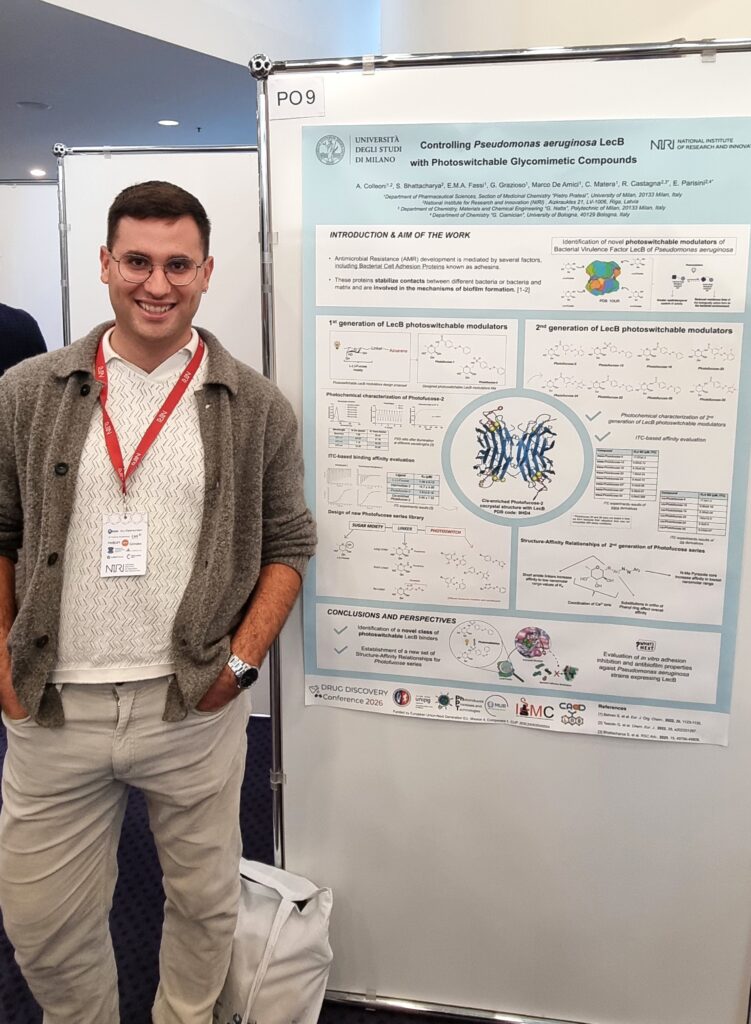
A second poster, presented by Alessio Colleoni (NIRI), explored how photopharmacology can be applied to antimicrobial resistance, focusing on hospital-acquired infections caused by Pseudomonas aeruginosa biofilms.
Because biofilms create a protective microenvironment that restricts antibiotic penetration, the researchers targeted LecB, a bacterial lectin that plays a key role in adhesion and biofilm stability. Building on an initial photoswitchable hit compound, they used a computationally guided, structure-based strategy to design new photoswitchable glycomimetic ligands able to modulate LecB in a light-dependent and reversible manner. Several optimised candidates showed enhanced binding affinity in their light-activated (cis-enriched) state compared with the reference compound, pointing to a versatile platform for the reversible, spatiotemporal control of bacterial adhesion.
Molecular prostheses to restore vision
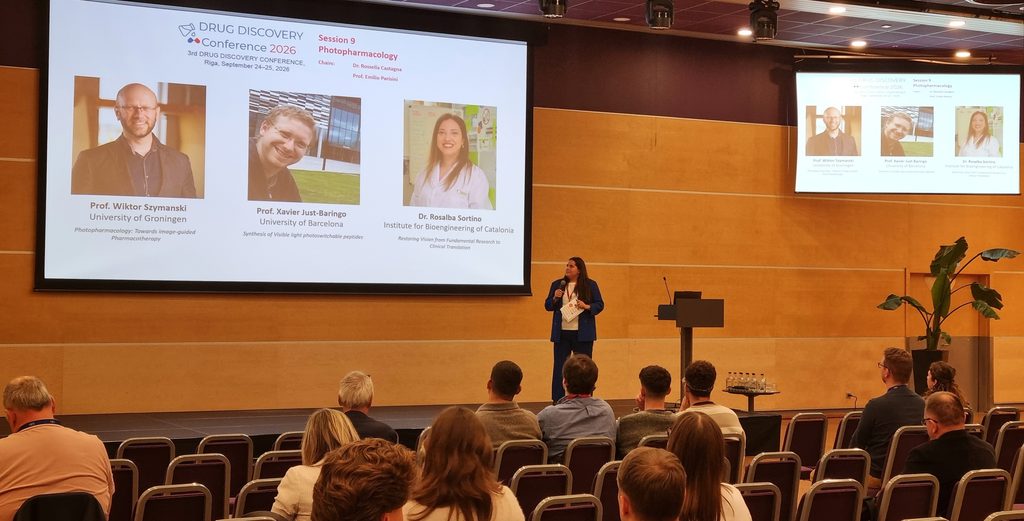
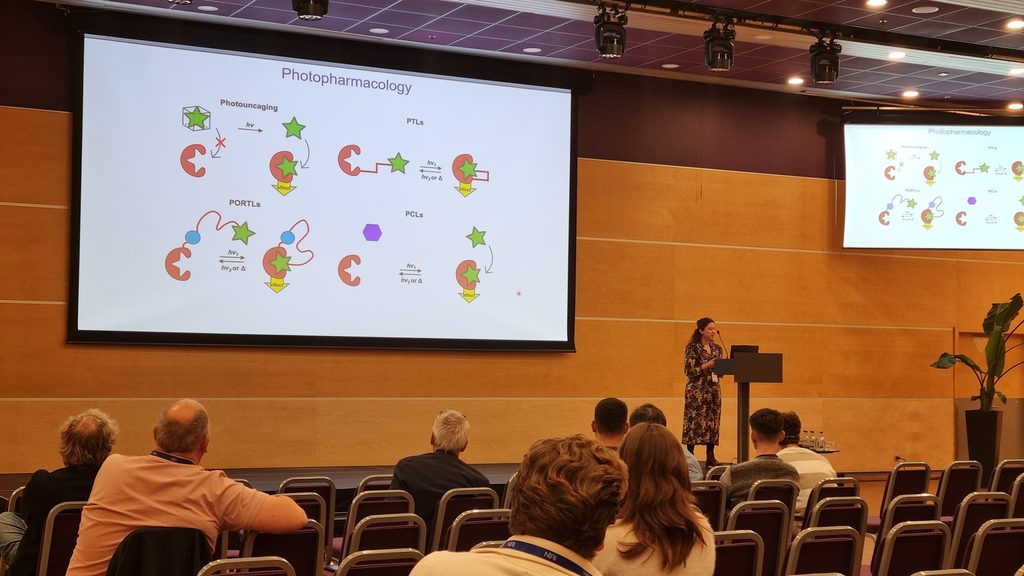
Photopharmacology also took centre stage in a dedicated lecture session hosted by Rossella Castagna (NIRI), which featured talks by Rosalba Sortino (IBEC), and other internationally recognized experts in the subject, such as Wiktor Szymanski (University of Groningen) and Xavier Just-Baringo (University of Barcelona).
Sortino presented the development of prosthe6, a family of photoswitchable small molecules targeting mGlu6 receptors in ON bipolar cells, the retinal neurons located just downstream of photoreceptors. Acting as “molecular prostheses”, these compounds can restore the light input to the retinal circuit after photoreceptor degeneration. In animal models, they recovered saccadic eye movements in blinded zebrafish larvae and restored innate light-avoidance behaviour in mouse models of geographic atrophy and retinitis pigmentosa under ambient white light, with two compounds also effective when administered topically. The results were recently published in the Journal of the American Chemical Society and covered on this website: A light switch for lost sight: new photopharmacology compounds restore sight in animal models.
From implantable platforms that deliver light deep inside the body to light-controlled molecules that can stand in for lost photoreceptors, the contributions presented in Riga illustrate the breadth of applications that photopharmacology is opening up. The Best Poster Award recognises the progress made by the PHOTOTHERAPORT team towards its core goal — remotely controlled, light-activated therapies that act locally and on demand — and the conference offered a valuable opportunity to share these results and exchange ideas with the wider drug discovery community.